Jesus The Temple (part 1)
“Destroy this temple, and in three days I will raise it up…But he spake of the temple of his body.” - Jn. 2:19b, 21
“For in him dwelleth all the fulness of the Godhead bodily.” - Col. 2:9
In Israel’s history, God had continually brought them out of an oppressed state and into a wilderness of uncertainty, requiring that they learn to trust God. The end result would be that the good promises of God would be fulfilled in their lives. At the time of Christ, the nation of Israel was under the oppression of Rome and was being bullied by corrupt religious leaders. This led to a cry for help and a plea for freedom. However, Jesus had not come to relieve them of cyclical fear and enslavement from a seen enemy, but to deliver them from fear of man and from the oppression of an unseen enemy. He came to make clear the will of God, not just by speaking it, but by doing it. He came to set in motion God’s plans and purposes to be fulfilled throughout all time.
When we were devoted to the worship of Satan, many of us did it mindlessly. To live without consideration of our Creator was easy. There were a plethora of evils we could engage in, because everything we did was of no eternal value. We, led by our own lust, reeked of eternal judgment in the nostrils of God. In our ignorance, we felt liberated while in the midst of emptiness and moments of sorrow. Our carelessness looked like peace and ease of life to those around us. We were in bondage, and our entire beings were used by Satan as instruments of deception. Coming out of such captivity, we now thoughtfully, even desperately, consider our Lord day after day. Into this wilderness we come. We did not know it was a wilderness until we were tested by its duration, its lack, and even its seeming monotony. Here we must learn to be transformatively devoted to the worship of our great God with every ounce of our being, in every second of our lives. We must be satisfied in Him alone. Jesus’ blood, shed by way of his death on the cross, satisfied the wrath of God against sinful humanity, that through faith we would believe and come out from enslavement to evil principalities and powers that have used sin and death to ensnare us. Now, having come out of enslavement worshipping Satan and self, and having once harbored a lifestyle of sin and selfish desires, what is here in this wilderness on the route to an eternity with God? Where is the temple?
Those whose hearts burn for the Lord, who adore Him and deeply desire to worship, will go as far as to seek out a private place to do so. Has not this been our custom? In a world that is absent from, and even rejects the public worship of God, His people will go as far as to seek out a room, a corner, and if none exist, they inwardly desire that one be designated for such a purpose. They will even build buildings to this end, to encourage public worship, in that perhaps, there are others whose hearts burn as well. This longing for God is not a symptom that can be treated through the erecting of altars, synagogues, temples, monasteries, cathedrals, or church buildings. This longing for God is a condition. God is the inexhaustible object of insatiable worship. Therefore, neither worship can be or should be confined to a time or a place. Both are to go wherever we go, and we wherever He leads. A world that does not pursue Him ought to be thought strange to us, and we experience real suffering and sorrow of heart because, as outcasts, we live in it. We fight day after day against evil, refusing to so much as be mildly entertained by it lest by continual exposure we develop a love for it.
We learn from the story of the woman at the well what our worship is to look like and how it is to be accepted by God, amid a world that rejects Him. In Jn. 4:19-26, a woman, who appeared to be a skeptic, perceived Jesus to be a prophet. He told her that there was living water that He would give her if she would first go and get her husband and come back. Surely no other man in whom she had come to know had ever been concerned about her past relationships when they themselves wanted to be in a relationship with her. Moreover, what He was offering was quite strange. Jesus says the water that He provides is better. It does not need to be drawn, but it operates as a natural spring from within you. It continuously shoots up from you, the well that holds it. Then it comes forth from the opening it finds, either erupting or flowing steadily. This woman supposedly knew that they were not talking about the same water. She had already questioned Jesus’ ability to provide for her when he himself was requesting and seemingly unable to supply himself with the water from the well they were standing in front of. He was speaking of the Holy Spirit, which in Jn. 7:37-39 tells us that a strong natural spring can create many streams and rivers. This water that Jesus gives will be in you as water in a well, but unlike a well, you will never run dry or be depleted of water. The water within will never become stagnant, but will spring up and flow out, acting as a supply for others, without end. Streams and rivers are primary sources of water when in the wilderness.
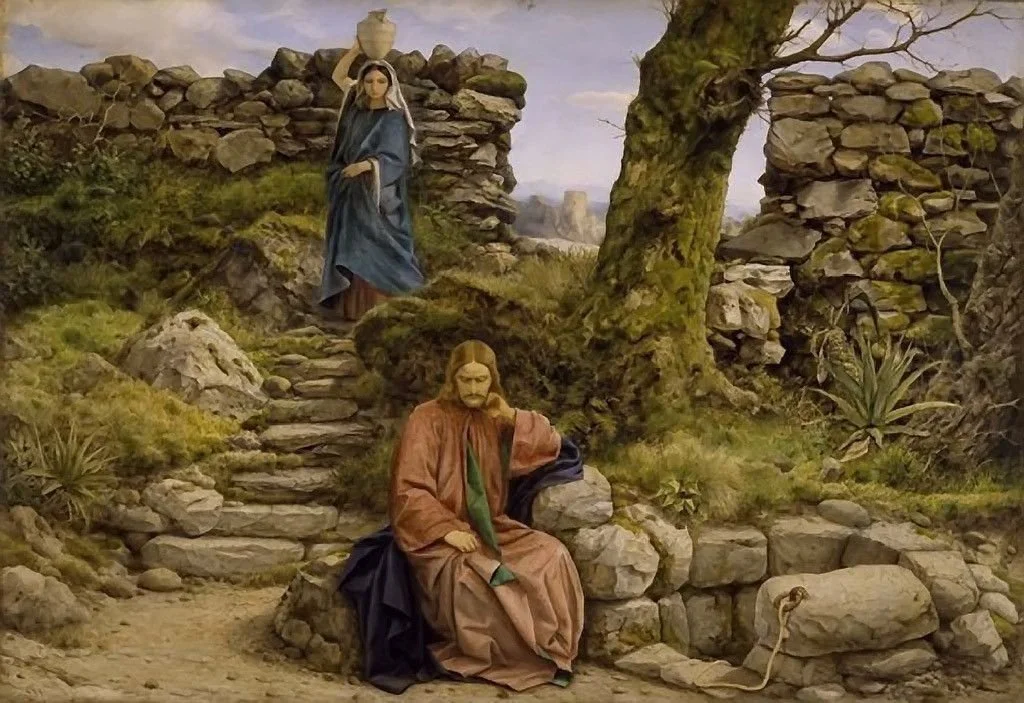
The Samaritan woman comes to the well to quench a periodic thirst, and the Lord who waits to offer something more.
Though the woman finally made her request of Him for living water, she still questioned, not knowing who it was who was talking to her; after all, the location that Jesus was telling her to come to in order to receive was uncommon in the least. Jesus had said that she and her husband were to come there….at the well? The woman may have thought, where are we going from here? During the time that the prophets of old told Israel and Judah to turn from their lifestyles of idolatry, adultery, various sins, to repent and return to the exclusive worship of God, there was certainly a place in their minds for the people to do so. The temple was available, and sacrifices and offerings for sin were still being done; however, as prophesied, they were not accepted by God due to the lack of repentance from the people who offered them, who chose to continue in disobedience. This woman was no different. Jesus had brought up her past and her present, that she had previously had five husbands, and the man she was currently with was not her husband. As a heart that is cold, and as a fool oblivious to his own foolishness, it was as if, without a blink, that she continued in conversation. She did not see why that was important. To her, that information could have been offered only to affirm to her Jesus’ authority, in that what He has to offer is from God. She thought, so where are we going to worship? There are two places mentioned, the place of custom (the mountains), which would have been the more familiar place for her. Or, the place of tradition that was common for and required by the Jews.
Jesus responded, bringing the conversation full circle. He said, neither here nor there, will you worship the Father, but the hour has come when you will worship from within. Jesus tells the woman, “The hour cometh, and now is, when the true worshipers shall worship the Father in spirit and in truth”. He says this is what the Father wants, and this is the only worship that He will receive. We are to worship Him from a place we cannot see (in spirit), and as one who lives or operates in accordance with His word (see Jn. 17:17), and not after lust (See 2Pet. 1:4; 1Jn. 2:15-17; Jam. 1:14).
This is where true worship begins, in spirit and in truth. Yet the indwelling presence of God, in the person of the Holy Spirit, as living water abiding within us as in a well that springs up unto eternal life, this is where true worship can take us. God’s claim to ownership of His people, His want and pursuit to commune and abide with His people, His desire for intimacy and oneness with His people, far surpass any understanding and longings that the believer may have in their needing and wanting to be with God. God walked and talked with us (mankind, His creation) in the Garden of Eden (See Gen. 3:8). He travelled and settled with Israel in the wilderness using a portable tent/tabernacle (See Ex. 25:8). He brought them into a land of their own and had a room built (the temple)(See 1Chr. 22:6-19), right next to theirs, His name fastened to it, in order to dwell among them. This still was not close enough for our God.
Seeing the suffering and sin sickness of His people, it was time now to identify with His people in order to deliver them from evil and the jaws of death. After all, if His people loved Him, then they would listen for Him, and to Him. If they loved Him, then by being as close as communion could bring (See Mt. 26:26-28), they would begin to look and act like Him. So much so that their presence would remind others of Him.
The word/mind of God present and used in the creation of the world, distinguishes the Creator from all of His creation, to then be put in a package wrapped in human flesh and delivered here, on earth, in the person of Jesus Christ. Colossians 2:9 tells us that, in Jesus, all the fullness of God lives in human bodily form. He is the complete image of the invisible God (See Col. 1:15). Unlike the former, the new earthly temple of God was a person, and through His life and ministry, God lived with His people, feeling as they felt, and much more. Whereas Solomon’s Temple was built, destroyed, rebuilt, expanded, and destroyed again, the temple of His body would see death due to the wrath of God against sinful humanity, but would be raised to life again and would live forevermore. People came from all over to lay eyes on this Temple. To hear the word spoken with authority proceed from Him mouth. To witness His compassion and power to heal and to deliver all who came to Him believing that He could. Yet our Lord prophesied of an even closer relationship with His people.
References
What does it mean that we are the temple of God (1 Corinthians 3:16)? (n.d.). GotQuestions.org. Retrieved May 3, 2026, from https://www.gotquestions.org/temple-of-God.html
The Exodus way. (n.d.). BibleProject. Retrieved May 3, 2026, from https://bibleproject.com/guides/the-exodus-way/