God’s House, God’s Way
Part 2
“Also the Lord telleth thee that he will make thee an house…I will set up thy seed after thee, which shall proceed out of thy bowels, and I will establish his kingdom. He shall build an house for my name and I will stablish the throne of his kingdom for ever…And thine house and thy kingdom shall be established for ever before thee: thy throne shall be established for ever.” (2Sam. 7:11-16)
In the earlier entry titled “God’s House, God’s Way” (Part 1), I shared some reasoning as to why David desired to build God a house, as well as the advantages that run alongside doing so. I ended the last blog post with this question: Is what we (the Church) are desiring to do for God, the same as what He desires to do in us? We will take a quick look at the progression of Israel's worship over the centuries to narrow down this question.
This would be a blessing to come full circle, that God would establish David’s house and his kingdom forever. David would start, many would come after in the order of David, but still another would finish and always remain. The fulfillment of these promises is seen along a trail that portrays the worship of God. The temple and temple worship will always be an essential part of the kingdom, in that it is God who established both Israel’s kingdom and nation. They are His people, and He is their God; without Him, there would be no kingdom and no nation of Israel. David, a man of worship and prayer who cultivated worship, as seen in numerous psalms written, would order night and day worship in obedience to God. (1Chr. 9:33; 2Chr. 29:25). Solomon, the son of David, would establish worship in the temple after his father’s order and command (see 2 Chr. 8:14). Once the first temple had been erected, worship and praise were set in place to happen night and day (nonstop). Every reformer after David, whether he be a king, priest, or leader during the first temple (built between 960 BCE and 967 BCE) or the second temple (built between 536 BCE and 516 BCE), sought to restore temple worship after the ordinance of David (2Chr. 20:5-13). Also, concerning David’s kingdom being an everlasting kingdom, this too was spoken by the angel Gabriel concerning Jesus the Christ who was of the seed of David and the fulfillment of this prophesy (See Rev. 22:16). The Bible says of Jesus in Luke 1:33: “And he shall reign over the house of Jacob for ever; and of his kingdom there shall be no end.”
David foreshadowing Christ and the temple to come:
Reasoning 1: David, who was chosen by God to be king over Israel, his kingdom, and his devotion to God while in leadership, became the blueprint for many generations after him. During David’s lifetime, a legacy was built on the promises and commands of Almighty God. This legacy ultimately affected the lives of people and nations for centuries, and paved the way for something and someone better. Again, as mentioned in part one, the call on David’s life was to draw the hearts of a nation of people to their God. All Israel knew that God was with David (See 1Sam. 18:12-16). We see this in the Lord Jesus who said, “I am the way, the truth, and the life: no man cometh unto the Father, but by me. If ye had known me, ye should have known my Father also: and from henceforth ye know him, and have seen him.” (Jn. 14:6-7).
The people saw David, and they witnessed his effective leadership. It was undeniable that God was with him; many followed him. We have something better today and something more still to come. It is all-encompassing and has no end. That is, no one comes to the Father but by Jesus. Romans 11:36 says, “For of him, and through him, and to him, are all things: to whom be glory for ever. Amen.” “For in him we live, and move, and have our being…For we are also his offspring.” (See Acts 17:28)
Reasoning 2: Under David’s authority, it was a united monarchy because one people would serve under the rule of one man, David, and all (including King David) from this permanent strategic military hub, by the grace of God would defeat regional enemies, and worship under the one true sovereign God. We are also under a monarchy, and there has been none other like it, nor will there be any other that will follow it. This monarchy in Christ is all-encompassing and eternal.
1Corinthians 15:24-28 reads, “Then cometh the end, when [Christ] shall have delivered up the kingdom to God, even the Father; when he shall have put down all rule and all authority and power. For he must reign, till he hath put all enemies under his feet. The last enemy that shall be destroyed is death. For he hath put all things under his feet. But when he saith all things are put under him, it is manifest that he is excepted, which did put all things under him. And when all things shall be subdued unto him, then shall the Son also himself be subject unto [God] that put all things under him, that God may be all in all.”
Reasoning 3: God gave instructions on how to construct the tabernacle. Moses and the Israelites followed those instructions; once completed, the glory of God filled it. So much so that Moses could not so much as enter. The cloud that would appear over the tabernacle by day, and the pillar of fire that would appear by night, indicated to Israel that the presence of God was there. They knew that God was with them. Israel's transition in the wilderness was determined by whether the presence of God in the form of the cloud would lift or settle (See Exodus 40:34-37). This portable tabernacle was a holy and accessible location where God could dwell among His people. Due to sin, He also could and would depart. The first temple, prepared by King David and built by Solomon, was a permanent replacement for the portable tabernacle. As it was with the tabernacle, so it was with the temple, in that the glory of the Lord filled it, so much so that “the priests could not stand to minister because of the cloud.” (See 1Kings 8:10-11). In the most holy place atop the Arc of the Covenant sat the mercy seat, where the presence of God was had in fear.
The differences between the tabernacle and the temple mirror the distinction between the way the Spirit of God came upon specific individuals in the Old Testament, compared to how He sought permanent indwelling in the New Testament. (See List of References Below). Those in the Old Testament in whom the Holy Spirit came upon were empowered to fulfill a specific task or purpose. They were called to be leaders, kings, judges, prophets, or craftsmen for the purposes of God. This empowerment was not permanent but temporary, often coming upon persons externally rather than internally. The first and second temples were built and rebuilt for the purpose of worship. Since long before the construction of the first temple, even before David sat as king over Israel, God desired to dwell among His people, to be their God. (See List of References Below). God would show His people exactly what needed to be done in order for Him to do so (see Heb. 8:5). He offered a construction pattern to which the tabernacle was to be built, this would be carried over into the construction of the temple, in the pursuit of a place that could accommodate the national worship of the God of Heaven who has desired to dwell with His people.
Music, along with the sacrificial system, the sabbaths and festivals, and the various ritual cleansings, were all a part of Old Covenant worship. During the period of the diaspora, synagogues were erected where Jews would assemble to listen to prayers and the torah read. Zerubbabel, the governor of Judah, alongside the Jews returning from Babylonian exile, rebuilt the Jewish Temple that had once been destroyed. During the time of Christ’s ministry on earth, Herod was the Roman-appointed king of Judea. Herod was responsible for expanding the 2nd Temple. Herod’s reasoning for this expansion was not that he sought to honor the God of the Jews. Nor to promote the worship and the pursuit of this God who was claimed to be above all gods and over all men. Rather, Herod did so in order to increase the wealth of his kingdom, solidify his reign over the region, and even to gain favor with the Jews who made up the majority of the population in Jerusalem and surrounding Judea.
Thoughts to Ponder:
Have we ever taken something that was sacred, something that was to be used exclusively for the purpose of honoring God, and instead, used it for our personal enjoyment, to draw attention to ourselves, or to ensure our position? Have we used our homes, our church buildings, or do we see our jobs as platforms for this purpose? If we belong to God, then it is possible that we do this whenever we give ourselves to something other than to Him and His purposes. Whenever we seek to promote self, or seek to be honored by man. In our celebration of holidays in the manner that our culture does. It could even be in the way we spend our free time. Where have we gone from His worship? Even our reasoning for the pursuit of Him is a cause for worship because He (God Almighty) has chosen to hear us and answer. Yet the journey from tabernacle, to first temple, to synagogues, to second temple, to expansion, to destruction, will be the journey of our gatherings if we cease to walk in purity of heart and righteousness. When the course of nations looks like our life, or when the progression and decline of biblical worship and its sacred halls appear to have the same pattern as our personal devotion to God today, then the scripture may in this become even more transparent and we are reminded: “Be not ignorant of this one thing, that one day is with the Lord as a thousand years, and a thousand years as one day.” (see 2Pet. 3:8) That is to say that there is no difference in practice and therefore there is no difference in outcome.
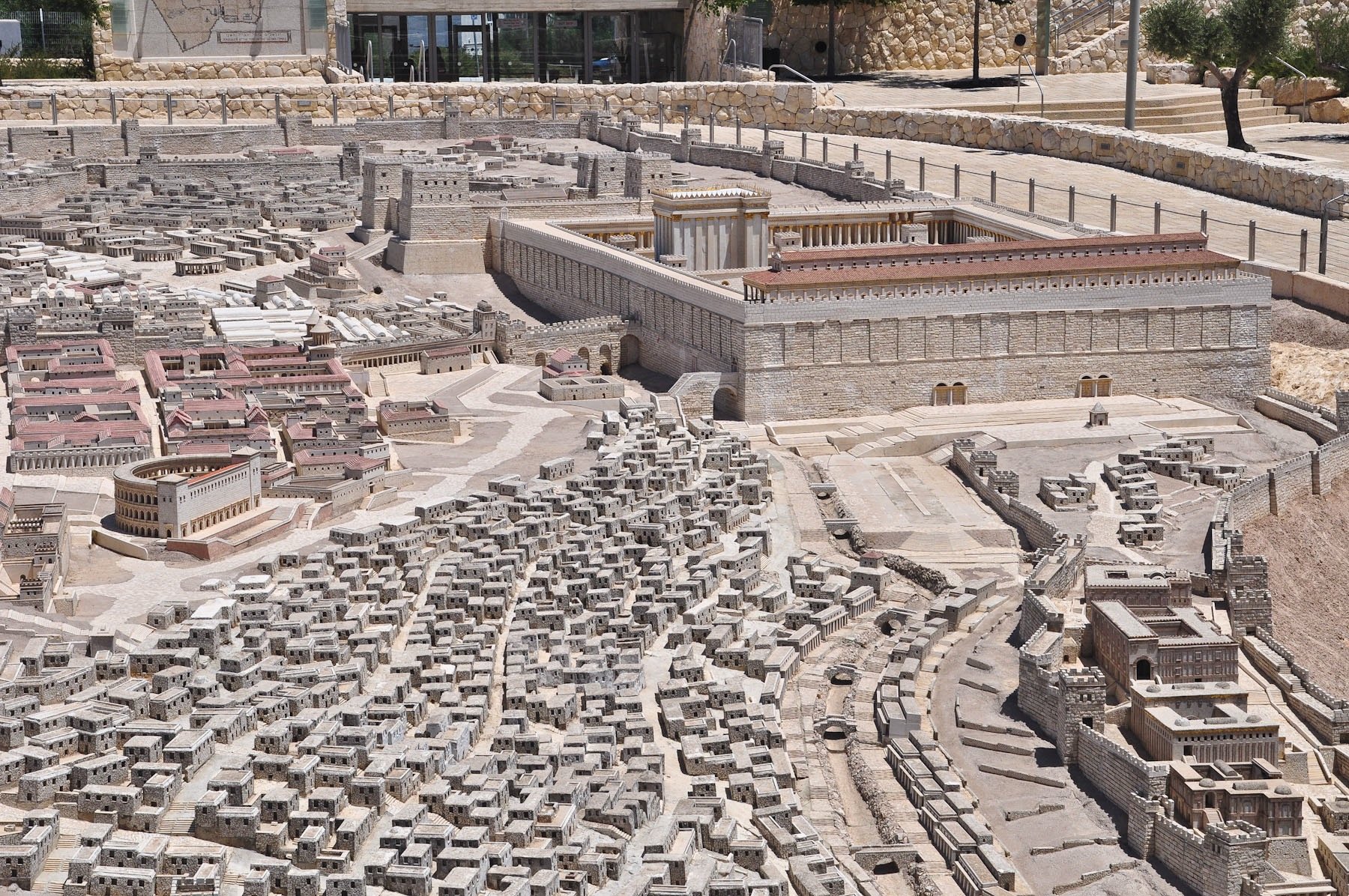
The Second Temple w/ Herod’s Expansions
This picture came from the HolyLandPhotos Blog, in an article titled “Model of Second Temple Jerusalem”. Please visit for more photos and detailed information.
https://holylandphotos.wordpress.com/2016/11/28/model-of-second-temple-jerusalem/
The 2nd Temple, with its expansions, was still not impressive to the one for whom it was built. When Jesus’ disciples made mention of the temple, thinking that Jesus would be in favor of its buildings, Jesus replied: “See ye not all these things? Verily I say unto you, There shall not be left here one stone upon another, that shall not be thrown down.” (Mt. 24:1-2). Earlier, upon reentering Jerusalem, “Jesus went into the temple of God, and cast out all them that sold and bought in the temple, and overthrew the tables of the moneychangers, and the seats of them that sold doves.” Then stated, “It is written, My house shall be called the house of prayer; but ye have made it a den of thieves.” (Mt. 21:12- 13). These statements leave us with the questions of: Where do we worship? And, how do we worship?
Scripture References
The Holy Spirit came upon individuals in the OT: Gen. 41:38; Num. 27:18; Deut. 34:9; 1Sam. 10:10; 19:20-23; 1Sam. 16:13, 23:1; Judg. 3:10; 6:34; 11:29; 13:25; 14:6; 15:14; Num. 11:25-26; 24:2; 2Chr. 15:1; 20:14; 24:20; Ezek. 2:2; 3:24; Micah 3:8; Ex. 31:2-5; 35:31
God desiring to dwell in the midst of His people: Ex. 25:8; 29:45-46; Lev. 26:11-12; Ezek. 37:27; Zech. 2:10
Other References
Sunshine, G. (2018, October 31). Worship: Part five, worship in the Old Testament. Breakpoint Colson Center. https://breakpoint.org/exploring-worship-5-worship-in-the-old-testament/
Mootz, J. (n.d.). Worship and prayer movement through history. Jeff and Bethany Mootz. http://jeffandbethanymootz.com/teaching-notes/
Ryen, D. B. (n.d.). The synagogue & diaspora. DB Ryen. https://www.dbryen.com/articles/biblical/synagogue-diaspora
Steppes of Faith. (2019, November 2). King Herod and his magnificent temple. https://www.steppesoffaith.com/apologetics/king-herod-magnificent-temple